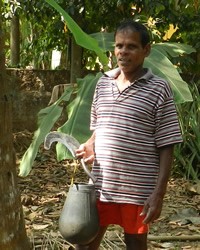

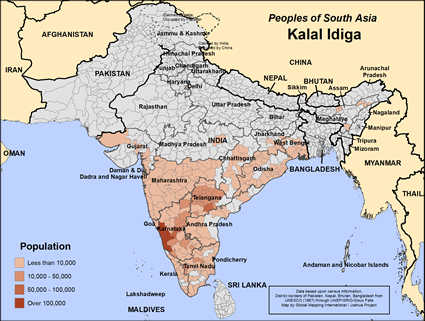
Kalal Idiga in India

The Kalal Idiga have only been reported in India
Population
Main Language
Largest Religion
Christian *
Evangelical
Progress
Progress Gauge
* Data can be from various sources including official census, agencies, and local research. Data from these sources can sometimes differ even by orders of magnitude. Joshua Project attempts to present a conservative, balanced estimate.

Introduction / History

The Kalal Idiga are a Hindu community found mainly in the southern Indian states of Andhra Pradesh, Telangana, Karnataka, and neighboring regions. They are also known in some places as Gowda, Ediga, Idiga, or Goud depending on local language and regional tradition. Historically, the community has been closely associated with toddy tapping, palm sap collection, distillation, and the production and sale of local alcoholic beverages. These occupations shaped much of their social identity within the traditional caste structure of South India.

The word "Idiga" is linked to the Telugu verb meaning "to draw," referring to the extraction of sap from palm trees. Over centuries, the Kalal Idiga developed specialized skills in climbing palm trees, tapping sap, fermenting toddy, and managing local liquor trade networks. Colonial records and ethnographic studies describe them as one of the traditional toddy-tapping communities of South India, alongside related groups such as the Billava, Gamalla, and Ezhava peoples.

Although toddy tapping historically carried low social status within parts of Hindu society because of its connection with alcohol production, many Kalal Idiga families gradually improved their economic and political standing during the twentieth century. Some entered agriculture, excise contracting, business ownership, education, and regional politics. In Karnataka and Telangana especially, the Idiga and Goud communities became politically organized and influential within broader Other Backward Class movements.

The Kalal Idiga primarily speak Telugu or Kannada depending on the region where they live. Community identity continues to be shaped by family lineage, caste associations, local traditions, and strong regional cultural ties.


What Are Their Lives Like?

Traditionally, the Kalal Idiga earned their livelihood through toddy tapping and liquor-related occupations. Men climbed palm trees to collect sap from palmyra and date palms, while families participated in fermentation, storage, transport, and sale of toddy and local alcohol products. This work required physical skill, endurance, and knowledge passed down through generations.


Today, many Kalal Idiga families have moved into other occupations. Some work as farmers, agricultural laborers, shopkeepers, transport workers, contractors, factory employees, or small business owners. Urban migration has increased as younger generations seek education and employment opportunities in cities such as Hyderabad, Bengaluru, and Vijayawada. Despite economic advancement for some families, many rural households still face unstable income, debt burdens, limited educational opportunities, and dependence on seasonal labor.

Village and family life generally center around extended family relationships and close community cooperation. Men often oversee outside labor and business activity, while women contribute significantly through household management, agricultural labor, small trade, and family support work. Weddings, religious festivals, and caste gatherings remain important social events that reinforce community identity and social relationships.

Many Kalal Idiga communities maintain strong internal organizations, educational societies, and caste associations that promote social advancement and political representation. Younger generations increasingly pursue higher education, technical careers, and government employment while balancing traditional family expectations and community identity.


What Are Their Beliefs?

The Kalal Idiga are Hindus, and Hindu beliefs shape much of their family and community life. Religious practices commonly include temple worship, household rituals, observance of Hindu festivals, pilgrimages, and devotion to regional gods and goddesses such as Shiva, Durga, Hanuman, Yellamma, and local village deities. Religious identity is closely connected to family tradition, caste relationships, and regional culture.

Traditional folk beliefs also remain influential within many communities. Belief in blessings, curses, astrology, ritual purity, ancestral customs, village spirits, and protective rituals may affect decisions involving illness, farming, marriage, finances, and family wellbeing. In some toddy-tapping traditions, offerings connected to palm sap collection and liquor vessels were historically practiced as part of occupational rituals.

Like many Hindu communities, the Kalal Idiga often see religion as deeply tied to inherited identity and social belonging. Religious observance commonly emphasizes ritual duty, family honor, and participation in festivals rather than personal spiritual transformation.

Very few Kalal Idiga have had meaningful exposure to biblical Christianity. Christianity is often viewed as foreign or outside accepted family and caste identity. Social pressure and fear of rejection can make openness to the gospel difficult. They need to hear clearly that forgiveness of sins and reconciliation with God come through Jesus Christ alone rather than through rituals, karma, caste identity, or religious tradition.


What Are Their Needs?

The Kalal Idiga remain largely unreached with the gospel, and there are relatively few known believers among them. Their strong integration into broader Hindu social structures and caste identity can make Christian witness difficult. Faithful Christian workers are needed who are willing to build long-term relationships, communicate biblical truth respectfully, and demonstrate the love of Christ through humility and compassionate service.

Practical needs vary between rural and urban communities. Some families continue to struggle with unstable employment, alcohol-related social problems, debt burdens, healthcare access, educational limitations, and economic uncertainty tied to seasonal labor or agriculture. Communities historically associated with liquor production may also experience social stigma from other caste groups.


The Kalal Idiga need Scripture resources, discipleship materials, and gospel teaching communicated in Telugu, Kannada, and other local languages they understand clearly. Personal relationships, oral communication, family-centered ministry, and compassionate community support may all help communicate the gospel effectively. Any believers among them would need encouragement, biblical training, and fellowship support because of social and family pressures connected to caste and religious identity.


Prayer Items

Pray that the Kalal Idiga people will hear a clear presentation of the gospel and place their faith in Jesus Christ for salvation.
Pray that God will raise up faithful Christian workers who are willing to serve among the Kalal Idiga with wisdom, humility, patience, and compassion.
Pray that the Kalal Idiga people will be adopted through the People Group Adoption program so that churches and believers will commit to sustained prayer and future gospel outreach among them.
Pray that any believers among the Kalal Idiga will grow strong in biblical truth and boldly share the hope of Christ with their families and communities.


Scripture Prayers for the Kalal Idiga in India.


References

https://en.wikipedia.org/wiki/Idiga
https://en.wikipedia.org/wiki/Goud
https://en.wikipedia.org/wiki/Gamalla
https://en.wikisource.org/wiki/Castes_and_Tribes_of_Southern_India/%C4%AAdiga
https://ncbc.nic.in/Writereaddata/addkar54.pdf
https://www.ijfmr.com/research-paper.php?id=40705


Profile Source:   Joshua Project  

People Name General Kalal Idiga
People Name in Country Kalal Idiga
Pronunciation kah-LAHL ee-DEE-gah
Alternate Names कलाल इड़िगा
Population this Country 1,861,000
Population all Countries 1,861,000
Total Countries 1
Indigenous Yes
Progress Scale Progress Gauge
Unreached Yes
Frontier Yes
GSEC 3  (per PeopleGroups.org)
Pioneer Workers Needed 37
PeopleID3 21147
ROP3 Code 115635
Country India
Region Asia, South
Continent Asia
10/40 Window Yes
National Bible Society Website
Persecution Rank 12  (Open Doors top 50 rank, 1 = highest persecution ranking)
Total States on file 16
Largest States
(only 15 largest shown)
Karnataka
981,000
Telangana
660,000
Tamil Nadu
100,000
Maharashtra
96,000
Andhra Pradesh
13,000
Kerala
2,200
West Bengal
1,700
Odisha
1,500
Goa
1,400
Gujarat
1,000
Chhattisgarh
800
Assam
600
Puducherry
400
Jharkhand
400
Delhi
300
Districts Interactive map, listing and data download
Specialized Website South Asia Peoples
Country India
Region Asia, South
Continent Asia
10/40 Window Yes
National Bible Society Website
Persecution Rank 12  (Open Doors top 50 rank, 1 = highest persecution ranking)
Total States 16
  Karnataka 981,000
  Telangana 660,000
  Tamil Nadu 100,000
  Maharashtra 96,000
  Andhra Pradesh 13,000
  Kerala 2,200
  West Bengal 1,700
  Odisha 1,500
  Goa 1,400
  Gujarat 1,000
  Chhattisgarh 800
  Assam 600
  Puducherry 400
  Jharkhand 400
  Delhi 300
Website South Asia Peoples
Primary Religion: Hinduism
Major Religion Estimated Percent *
Buddhism
0.08 %
Christianity
0.00 %
Ethnic Religions
0.00 %
Hinduism
99.90 %
Islam
0.00 %
Judaism
0.00 %
Non-Religious
0.00 %
Other / Small
0.02 %
Sikhism
0.00 %
Unknown
0.00 %
* From latest India census data.
Current Christian values may substantially differ.
Primary Language Telugu (774,000 speakers)
Ethnologue Language Code tel
Ethnologue Language Familly Dravidian
Glottolog Language Family Dravidian
Written / Published Yes   (ScriptSource Listing)
Total Languages 11
Secondary Languages
Kannada
455,000
Tulu
172,000
Konkani
165,000
Konkani, Goan
107,000
Marathi
52,000
Tamil
6,100
Hindi
4,700
Bengali
700
Gujarati
400
Chhattisgarhi
20
Primary Language Telugu (774,000 speakers)
Ethnologue Language Code tel
Ethnologue Language Familly Dravidian
Glottolog Language Family Dravidian
Written / Published Yes   (ScriptSource Listing)
Total Languages 11
Secondary Languages
  Kannada 455,000
  Tulu 172,000
  Konkani 165,000
  Konkani, Goan 107,000
  Marathi 52,000
  Tamil 6,100
  Hindi 4,700
  Bengali 700
  Gujarati 400
  Chhattisgarhi 20

Primary Language:  Telugu

Bible Translation Status  (Years)
Bible-Portions Yes  (1812-1966)
Bible-New Testament Yes  (1818-1989)
Bible-Complete Yes  (1854-2022)
FCBH NT (www.bible.is) Online
YouVersion NT (www.bible.com) Online
Possible Print Bibles
Amazon
World Bibles
Forum Bible Agencies
National Bible Societies
World Bible Finder
Virtual Storehouse
Resource Type Resource Name Source
Audio Recordings Audio Bible teaching Global Recordings Network
Audio Recordings Love letter to you from scripture Father's Love Letter
Audio Recordings Online Audio Scripture Talking Bibles
Audio Recordings Oral Bible stories One Story
Film / Video Following Jesus video Jesus Film Project
Film / Video God's Story video God's Story
Film / Video Jesus Film: view in Telugu Jesus Film Project
Film / Video LUMO film of Gospels Bible Media Group/LUMO
Film / Video Magdalena video Jesus Film Project
Film / Video My Last Day video, anime Jesus Film Project
Film / Video Rivka video Jesus Film Project
Film / Video Rock International: King of Glory Rock International
Film / Video Story of Jesus for Children Jesus Film Project
Film / Video The Hope Video Mars Hill Productions
Film / Video World Christian Videos World Christian Videos
General Bible for Children Bible for Children
General Bible in text or audio or video South Asia Bibles
General Biblical answers to your questions Got Questions Ministry
General Faith Comes By Hearing - Bible in text or audio or video Faith Comes by Hearing
General Gospel website in this language General / Other
General Scripture Earth Gospel resources links (Neethakani) Scripture Earth
General Voice of the Martyrs resources Voice of the Martyrs
General YouVersion Bible versions in text and/or audio YouVersion Bibles
General Zume Resources Zume Project
General Zume Training Zume Project
Mobile App Android Bible app: Pastors Telugu Study Bible Grace Ministries and Dusty Sandals
Mobile App Android Bible app: Study Bibles (Multiple Languages) Grace Ministries and Dusty Sandals
Mobile App Android Bible app: Telugu YouVersion Bibles
Mobile App Android Bible App: Telugu Bible (తెలుగు బైబిల్) Indian Revised Version (IRV) Operation Agape
Mobile App Android Bible app: Telugu Study Bible Grace Ministries and Dusty Sandals
Mobile App Android Bible Radio app: Telugu Bible Radio Shalom Design S2dio
Mobile App Android Book Reading app: Open Bible Stories (Telugu) Shalom Design S2dio
Mobile App Children's Bible app Bible4Kidz
Mobile App Download audio Bible app as APK file Faith Comes by Hearing
Mobile App Download audio Bible app from Google Play Store Faith Comes by Hearing
Mobile App iOS Bible app: Telugu YouVersion Bibles
Mobile App iOS Bible Radio App: Telugu Bible Radio iOS Revive India
Text / Printed Matter Children and youth resources One Hope
Text / Printed Matter Literacy primer for Telugu Literacy & Evangelism International
Text / Printed Matter The Ancient Path Live Global
Text / Printed Matter tools for gospel conversations Cru
Text / Printed Matter Topical Scripture booklets and Bible studies World Missionary Press
Photo Source Negliea - Wikimedia  Creative Commons 
Map Source People Group data: Omid. Map geography: UNESCO / GMI. Map Design: Joshua Project.  
Profile Source Joshua Project 
Data Sources Data is compiled from various sources. Learn more.
